PKP
Penetrating Keratoplasty
Full-thickness corneal transplantation
On this page
The cornea is critical for focusing light and achieving clear vision. When its clarity or structural integrity is severely compromised by disease, injury or previous surgical complications, vision can be drastically affected. Where the damage extends through multiple layers of the cornea, a full-thickness corneal transplant — penetrating keratoplasty (PKP) — has long been the gold standard and remains a vital procedure.
While newer lamellar, partial-thickness techniques have emerged for specific conditions, PKP offers a comprehensive solution when the entire corneal thickness is compromised.
Understanding penetrating keratoplasty
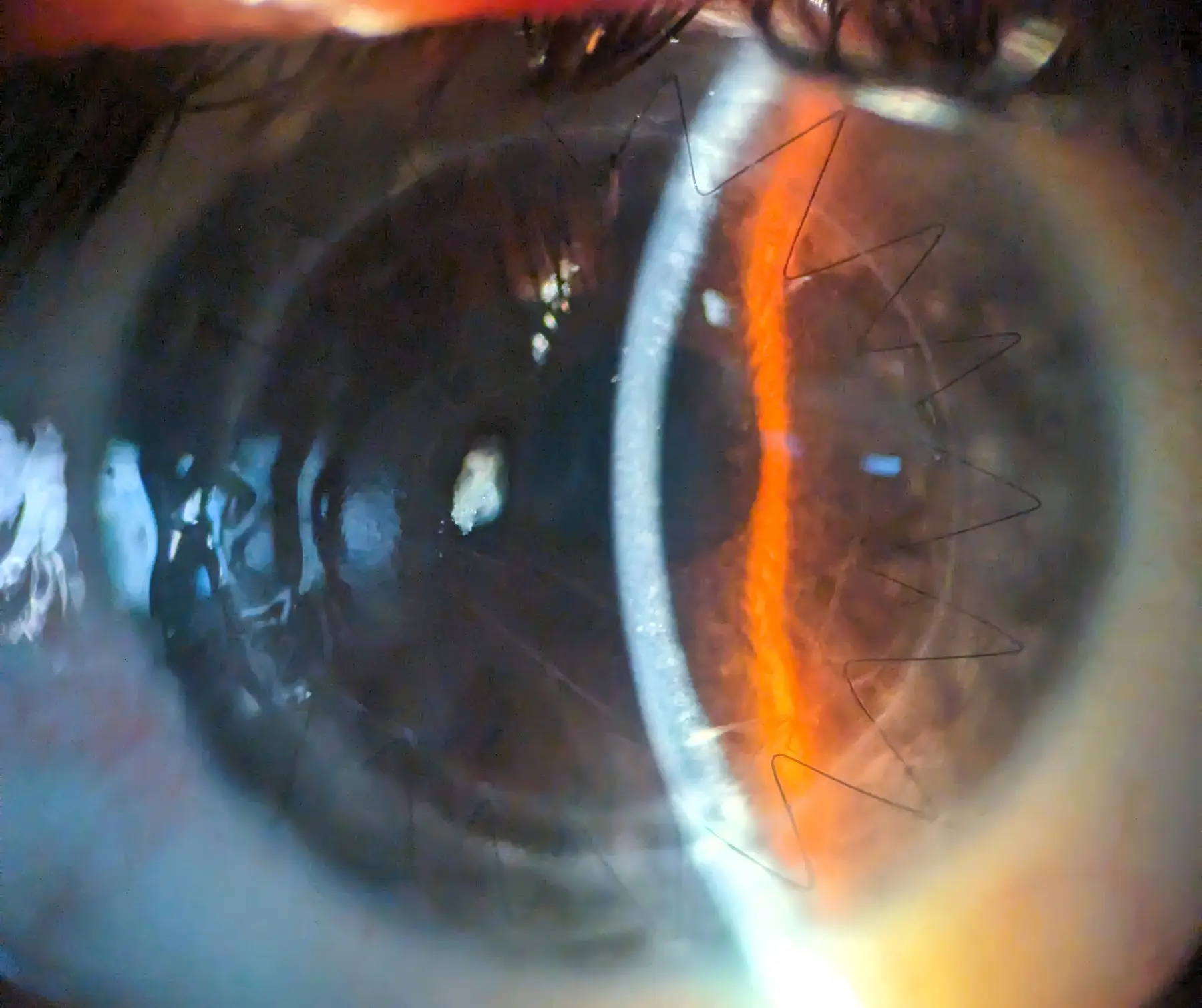
PKP involves the surgical removal of the patient’s entire central diseased or scarred cornea, typically using a specialised circular blade called a trephine. A precisely matched full-thickness donor cornea — the graft — obtained from a human donor through an eye bank, is then carefully sutured into place with numerous very fine stitches.
The goal is to replace the opaque or misshapen host cornea with a clear, healthy donor cornea, restoring a smooth optical surface and allowing light to pass unhindered to the retina.
When is PKP indicated
PKP is a versatile procedure indicated for a wide range of conditions affecting the full thickness of the cornea:
- Advanced keratoconus, where the cornea has become excessively thinned and cone-shaped and other treatments are no longer effective
- Significant corneal scarring from infection (herpetic keratitis, bacterial or fungal ulcers), trauma or chemical burns
- Certain corneal dystrophies — genetic conditions affecting multiple layers of the cornea, leading to clouding or structural instability
- Corneal perforation or thinning, where there is a risk of rupture
- Failed previous corneal grafts, whether penetrating or lamellar
- Bullous keratopathy in severe cases where the entire cornea is swollen and opaque and endothelial keratoplasty alone may not suffice
The decision to proceed with PKP is made after thorough evaluation, considering the nature and extent of the corneal pathology and the balance of benefit and risk for the individual patient.
The surgical process and key considerations
PKP is typically performed under general or local anaesthesia. It is a meticulous procedure requiring precision both in removing the host cornea and in suturing the donor tissue.
- Visual recovery is generally gradual. Some improvement may be noted relatively soon, but optimal vision often takes many months — sometimes a year or more — as the graft heals and sutures are managed or removed.
- Astigmatism. Because of the nature of a full-thickness graft and the presence of sutures, significant astigmatism is common after PKP. This often requires correction with glasses, specialised contact lenses, or sometimes further refractive surgery.
- Suture management. Sutures typically remain in place for an extended period, often a year or longer, and are selectively removed or adjusted to help shape the cornea and manage astigmatism.
- Graft rejection. The immune system can recognise the donor cornea as foreign and attempt to reject it. Long-term topical steroid drops are usually necessary to minimise this risk, which is generally higher with PKP than with lamellar procedures.
- Structural integrity. While the graft heals strongly, the eye may remain somewhat more susceptible to injury after PKP.
The enduring role of PKP
Despite advances in lamellar keratoplasty, PKP remains an indispensable tool in the corneal surgeon’s armamentarium. For many patients with severe, full-thickness corneal disease it offers the best — and sometimes only — chance of significant visual restoration. It is a well-established procedure with a long record of success in treating complex corneal conditions.
Recovery can be longer and more involved than with some newer techniques, but the potential to restore sight for patients with otherwise intractable corneal blindness makes PKP a cornerstone of ophthalmic surgery.
Sources
Updated: